
31 October rain, more rain, some wind, more rain, hail?? Dirty, wet socks. Happy Hallowe’en, Samhain, All-Hallows, etc.!
QB and KB shod in their most waterproof gear headed to Samos and then Sarria. Samos was a great surprise, beautiful city on a nice river (waterfall for the mill), with its large monastery. More on this below.
QB soldiering on with a hurt and painful knee; naturally determined to try and finish this walk, especially as we are so close to the end. Less than 150 km to go. Amazingly wet for the past two days, apparently typical of Galicia, which is very green and lush, even in autumn. Jeff saw two large white turkeys en route to Sarria. I missed them entirely and am severely disappointed.
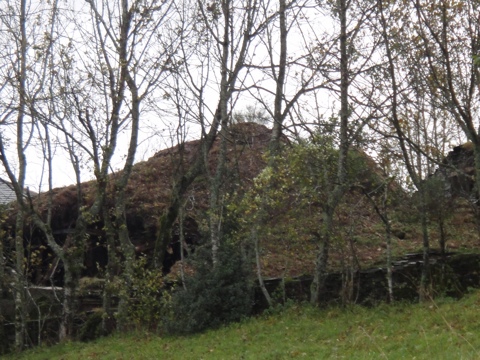
Started this entry while still in Triacastela (the correct spelling ). There has been no net connection for a few days – not surprising as we have been on an isolated mountain with few people other than tourists. Have in staying in clean dumps with borderline hostile hosts. Last night’s joint had little heat and beds less comfy than a floor. The place in O’Cebreiro was a stone building. The bar was empty for the most part, except for the family. Their taciturnity (to put it mildly), heads of long-dead boars and deer, expired calendars with religious symbols and lack of heat on a cold rainy evening helped create a rather gothic atmosphere. Good for Hallowe’en.
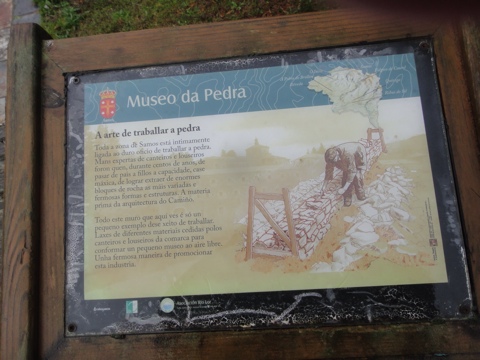
In the 12th C it was traditional for pilgrims to carry some of the calcium rich stones to the ovens in Castañada where they were made into cement for the construction of Compostela Cathedral.
First, some language stuff about Gallego (have seen it spelled both with one and with two l’s).
This is the westernmost of the Romance languages having split off from Latin in the early Middle Ages. During the reconquesta the language moved South and today its Southernmost form is Portuguese.
Some spelling changes:
el and la have become o and a respectively
n has become ñ as in camiño
some sharp vowels have become diphthongs. -ero —> -eiro
final vowels tend to be pronounced u
Gallego was considered a court language in Leo’n as late as the 13th century.
Above excerpted from “The Pilgrimage Road to Santiago”
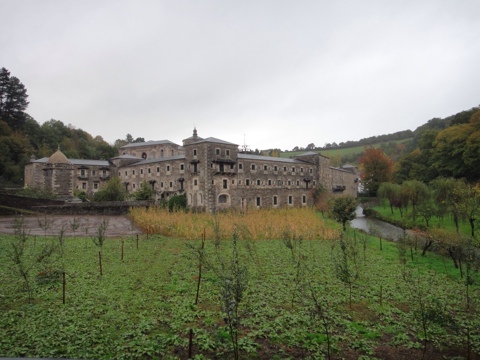
The road from Triacastela to Sarria passes through Samos which has a monastery founded in the 6th C. Over time it became rich, was favored by Monarchs and later controlled 200 towns, 105 churches, and some 300 monasteries. It is certainly good to be favored. Benedictine and part of the Cluny network. At some point in its later history, part of the monastery needed some rebuilding due to an alcohol fueled explosion.
The monastery in Samos is reputedly the largest in Western Europe and in almost continuous use since the Benedictine’s arrival. Being a Sunday no tours until after mass. Timing and rain did not permit hanging around for a few hours.
The food has continued to improve a bit as we move further into Gallacia. The standard soup (a type of minestra of green leaves, beans and potatoes) has gotten richer. Usually called “Caldo xxxx” where xxxx is the region. Pulpo quite common. Excellent beer and the ubiquitous too-sweet red wine, served cold. It seems like it is served even colder here, hard to tell. From memory it seems the cold red started in Navarra, probably in Rioja.
Some pictures have been posted on the usual flickr site, today’s date.

1-3: O Cebreiro palazzos
4: inside a Romanesque church, much restored, there
5-7: inside shots of a pallozo
8: outside shot of same one
9-12: Outside of Monastery at Samos
Monastery at Samos
Some practice Spanish
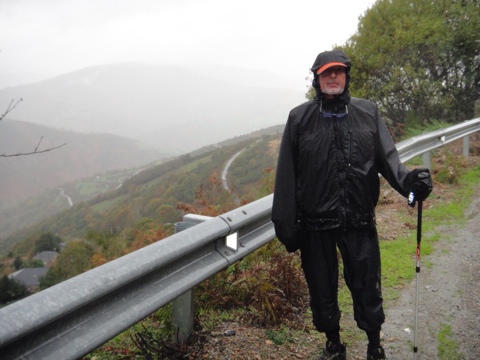
KB at the top of a pass


 Boog's Blog