
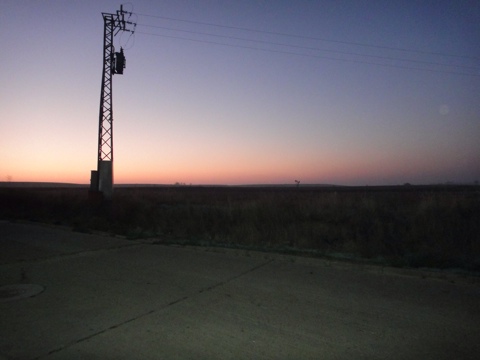
17 October Usual high Meseta weather, cold in the mornings warm, later in the sun. High and dry climate in the Meseta Alta (see sunrise art photo)
Massive KB illness. QB knee unstable but functional for short distances with trekking poles.
There are two blogs here. QB added a section and some editing. QB is currently resting. I need a little less now as will be revealed.
We are on different trips.
In QB’s version I am running down and need of a recharge. In my version I was attacked by Bio-Ag, a little known but powerful energy sapping agent (Judi–possibly the Cabal at work) featuring fever and exhaustion and joint aches. Just sucks the life out of you for 24-36 hours.
Bio-Ag has targeted me at least twice before. Once in Canada, while cycling to Victoria, almost exactly 10 years ago, QB’s %0th, and laid me low for a day. Symptoms are flu like (joints ache – but on this trip hard to know what is different and what is Big-Ag, low grade fever, no energy, no appetite, no cough or sneezing, just a need to sleep) and once several years ago at home. Used to think it was the Russians, then the French, but since Obama we are now friends with everyone; well, almost.
Walking across the Meseta Alta is what I imagine walking across the plains states would be, except with the occasional picnic bench, but no public toilets and not enough fluffy bushes for easy pit stops. The air is becoming very chilly as the sun rises late around 8:30. I am walking west, so the sun is at my back as it climbs, very pleasant as the world warms. No humidity at the moment so sky is brilliant and edges sharp until afternoon when clouds start to show.
Fortunately, Sahagun was a planned rest day, could not have ridden anyway, so was able to sleep for almost 36 hours except when properly forced to drink liquids. Seem to be over it today and will try the Camino tomorrow, as will the QB.
Sahagun is a very old place. Has been fought over by Muslims, Charlemagne, a big battle where reputedly 40000 Christians died, and a list of suitors too varied to summarize here. Eventually “given” to the Monastery of Cluny, yes a bit away from here, and then it prospered with wool being a big export to Europe across the Pyrenees. At one point the monastery here controlled 90 other spanish monasteries; then the Cistercians (a distinction I do not understand) became more powerful.
In the next days, we are hoping to see the cañsades, 10 meter wide roads, with walls, used for the annual sheep migration. Sometimes 40 thousand sheep at a time, although don’t know how much of this still goes on. In winter the sheep graze the harvested wheat fields, and in summer go to higher mountains while the wheat grows and they grow. Black faced merino sheep from North Africa well suited for the very variable climate.
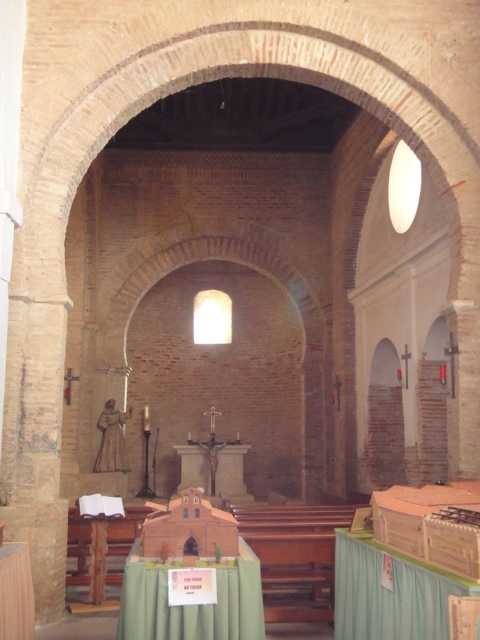
Naturally much architecture has been destroyed because of the love of this place. The church (San Tirso) in best repair is quite interesting as it has features of both Roman and Muslim architecture. Lots of bricks (much lighter than the stone pillars, and favored even when stone was available), less ornamental, wood pillars, horse shoe shaped portals rather than simple Roman ones. The book we have has pages on the differences and preferences. Very nice to see even without the detailed knowledge. Also where large painted figures for holiday processions are stored.
Pictures of the San Tirso church, very interesting and different, at the usual flickr location of this date – as of interest to the medievalists and maybe others.


 Boog's Blog